

Why Dermatologists in Nepal Are Seeing More Damaged Skin Than Ever Before
Dermatologists in Nepal are seeing increasing cases of sensitive skin, skin barrier damage, acne flare-ups, and irritation caused by excessive skincare routines, viral TikTok trends, and overuse of active ingredients.

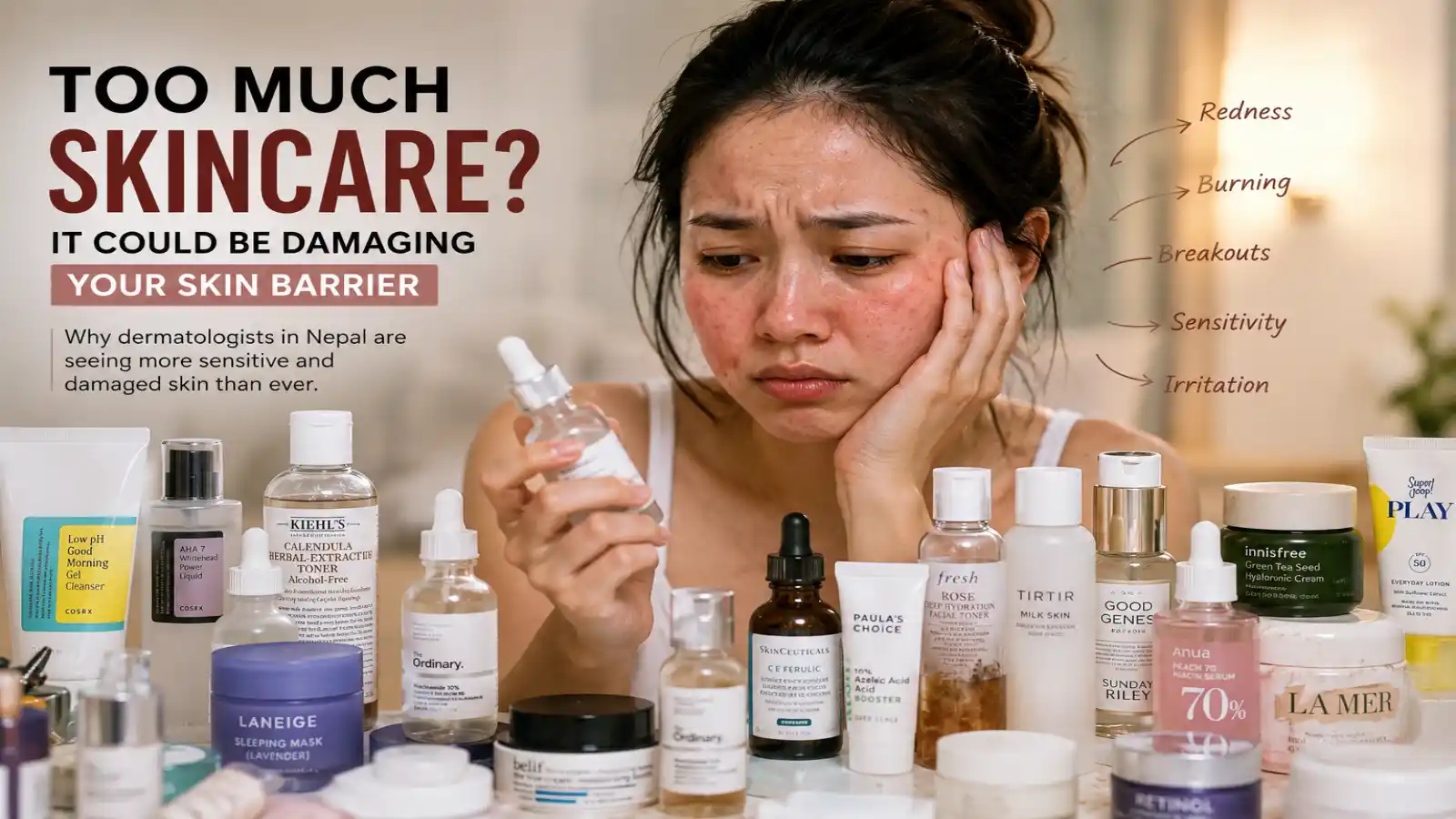
Why Dermatologists in Nepal Are Seeing More Damaged Skin Than Ever Before
The Modern Skincare Problem Nobody Is Talking About
Many patients now walk into dermatology clinics carrying bags full of expensive Korean and American skincare products — yet their skin barrier is severely damaged.
At Diva Skin City Butwal, dermatologists are increasingly seeing patients with burning, redness, irritation, acne flare-ups, dryness, sensitivity, and damaged skin barriers caused not by lack of skincare, but by excessive and inappropriate skincare routines inspired by TikTok and Instagram trends.
Ironically, many of these patients are using products that are globally popular, scientifically formulated, and extremely expensive — but not necessarily suitable for their skin type, skin barrier condition, lifestyle, or Nepal’s climate.
Earlier, dermatologists commonly treated under-treated skin.
Today, we are increasingly treating over-treated skin.
And this shift is happening rapidly across Nepal.
The Rise of Sensitive Skin in Nepal
Over the past few years, “sensitive skin” has become one of the most common complaints in dermatology clinics.
Patients frequently say:
- “Doctor, my skin burns after washing.”
- “Nothing suits my skin anymore.”
- “Even moisturizer irritates my face.”
- “Suddenly my skin became very sensitive.”
- “I never had acne before using skincare.”
- “My skin feels hot all the time.”
- “Every serum causes tiny bumps.”
Many people believe they suddenly developed weak skin.
But in reality, many are experiencing damaged skin barriers caused by excessive skincare experimentation.
How TikTok and Instagram Skincare Trends Are Affecting Skin Health
Social media has dramatically changed skincare culture in Nepal.
Earlier, most people used:
- soap
- moisturizer
- maybe sunscreen
Now many teenagers and young adults use:
- exfoliating acids
- retinol
- glycolic acid
- salicylic acid
- niacinamide
- vitamin C
- peeling solutions
- chemical exfoliants
- multiple serums layered together
Most of these products are not inherently bad.
The problem is:
- overuse
- incorrect combinations
- excessive frequency
- using actives on damaged skin
- following routines without understanding skin type
Many people are unknowingly treating their skin like a social media experiment.
The “More Products = Better Skin” Myth
One of the biggest misconceptions in modern skincare is the belief that:
More products create better skin.
In reality, healthy skin is not created by using the maximum number of products.
Healthy skin is created by using the right products appropriately.
Many patients now follow:
- 8-step routines
- 10-step Korean skincare routines
- multiple acids together
- daily exfoliation
- strong retinol without supervision
The result is often:
- irritation
- redness
- acne flare-ups
- skin barrier damage
- increased sensitivity
Some patients are actually damaging perfectly healthy skin while trying to achieve “glass skin” seen online.
Why Expensive Skincare Products Can Still Damage Skin
One of the most difficult conversations dermatologists now face is this:
“Doctor, this product is imported.”
“This serum is from Korea.”
“This cream cost NPR 15,000.”
“TikTok dermatologists recommend this.”
“How can your simple moisturizer be better?”
This is understandable.
People naturally associate:
- expensive products
- foreign brands
- luxury packaging
- viral popularity
with better results.
But skincare does not work like fashion branding.
Even excellent skincare products can trigger irritation if:
- they are overused
- mixed incorrectly
- used on damaged skin
- unsuitable for the person’s skin type
- unsuitable for the climate
A product being expensive does not automatically mean it is suitable for everyone.
Why Nepal’s Climate Matters More Than People Realize
Most viral skincare trends online originate from:
- Korea
- the United States
- Europe
But Nepal has very different environmental conditions.
Many parts of Nepal experience:
- high UV exposure
- heat
- humidity
- sweating
- dust
- pollution
Skin routines copied directly from colder or less humid countries may not always suit everyone living here.
For example:
- excessive exfoliation in hot climates may worsen irritation
- heavy layered skincare may worsen acne in oily skin
- strong retinol on already inflamed skin may trigger severe barrier damage
This does not mean Korean or American skincare is bad.
It means skincare must be individualized.
Signs Your Skin Barrier May Be Damaged
The skin barrier is the outer protective layer of the skin responsible for:
- retaining moisture
- protecting against irritants
- maintaining healthy skin balance
When damaged, symptoms may include:
- burning sensation
- redness
- tightness
- itching
- flaky skin
- stinging after applying products
- sudden acne breakouts
- increased oiliness
- tiny bumps
- skin becoming reactive to everything
Many patients continue adding more products to “fix” the problem — which often worsens the irritation further.
The Hidden Problem of “Skincare Cocktailing”
Dermatologists are now seeing a growing trend called “skincare cocktailing.”
This happens when people mix:
- retinol
- exfoliating acids
- benzoyl peroxide
- vitamin C
- multiple serums
- DIY skincare hacks
without understanding ingredient interactions.
Some people use:
- exfoliating acids every night
- retinol daily from the beginning
- harsh scrubs together with active ingredients
The skin barrier eventually becomes inflamed and unstable.
Unfortunately, social media often normalizes over-treatment.
Skin Care Has Become Emotionally Complicated
Modern skincare is no longer only about skin.
It is also about:
- identity
- self-image
- social media validation
- trends
- aesthetics
- consumer culture
Many people now feel emotionally attached to expensive skincare purchases.
This makes it psychologically difficult to simplify routines even when their skin barrier is clearly irritated.
Some patients are not only seeking treatment.
They are also seeking validation that their expensive skincare choices were correct.
This is one reason why minimalist dermatologist regimens are sometimes underestimated.
Why Dermatologists Often Recommend “Simple” Skincare
Patients are sometimes surprised when dermatologists recommend:
- gentle cleansers
- barrier repair moisturizers
- sunscreen
- one treatment cream
instead of complicated multi-step routines.
But this simplicity is often intentional.
Inflamed skin usually heals better with:
- fewer irritants
- reduced inflammation
- controlled active use
- barrier restoration
In many cases, skin improves not because more products were added —
but because unnecessary irritation was removed.
The Steroid Cream Problem in Nepal
Another major issue worsening sensitive skin in Nepal is unsupervised steroid cream use.
Many fairness creams and over-the-counter combination creams contain steroids.
Initially these creams may temporarily:
- reduce redness
- suppress pimples
- brighten skin
But long-term misuse can cause:
- thin skin
- acne flare-ups
- redness
- steroid dependence
- severe sensitivity
- visible blood vessels
Dermatologists across Nepal are seeing increasing numbers of patients with steroid-damaged skin barriers.
What Dermatologists Actually Want Patients to Understand
Dermatologists are not against skincare.
Good skincare absolutely works.
Scientific skincare has transformed acne treatment, pigmentation treatment, anti-aging therapy, and skin health.
But skincare should not become uncontrolled experimentation.
Skin health is not a competition to use the highest number of products.
And healthy skin does not require constantly damaging the skin barrier in pursuit of perfection.
How Dermatologists Repair Damaged Skin Barriers
Treatment usually focuses on:
- reducing irritation
- restoring barrier function
- simplifying routines
- controlling inflammation
- identifying triggers
Depending on the condition, treatment may include:
- gentle cleansers
- barrier repair moisturizers
- anti-inflammatory treatment
- controlled use of actives
- sunscreen
- acne management
- treatment of steroid damage
Recovery often takes patience because irritated skin needs time to heal.
When You Should Stop Experimenting and Visit a Dermatologist
You should consult a dermatologist if you experience:
- persistent burning
- redness
- worsening acne
- skin sensitivity
- irritation from every product
- peeling
- itchy skin
- damaged skin after skincare use
Early treatment can prevent long-term skin barrier damage and chronic sensitivity.
Final Thoughts
Modern skincare has made people more aware of skin health than ever before.
That is a positive change.
But social media has also created an environment where many people feel pressured to constantly try stronger products, more products, and newer trends without understanding what their skin actually needs.
Sometimes the healthiest thing for skin is not adding more.
Sometimes it is simplifying.
And sometimes the most effective skincare routine is not the most expensive one —
but the one that respects the skin barrier.
As dermatologists in Nepal increasingly see patients with over-treated and irritated skin, one message is becoming clearer:
Healthy skin is built through balance, consistency, and science — not skincare overload.
Frequently Asked Questions
Can too much skincare damage skin?
Yes. Excessive use of exfoliants, retinol, acids, and multiple active ingredients can damage the skin barrier and cause irritation.
Why does my skin burn after using skincare products?
Burning or stinging may indicate skin barrier irritation, allergy, over-exfoliation, or inappropriate product use.
Can retinol damage skin?
Retinol can irritate skin when used too frequently, at high concentrations, or on already sensitive skin.
Are expensive skincare products always better?
No. Suitability depends on skin type, climate, skin barrier condition, and correct usage — not just price.
When should I visit a dermatologist for sensitive skin?
If your skin becomes persistently irritated, red, acne-prone, or reactive to most products, dermatologist evaluation is recommended.
About Diva Skin City Butwal
Diva Skin City is a modern dermatology and skin clinic in Butwal focused on evidence-based treatment for acne, hair fall, pigmentation, fungal infections, sensitive skin, laser procedures, and skin barrier repair.
The clinic provides personalized dermatologist-guided skincare based on skin type, climate, lifestyle, and medical diagnosis rather than viral skincare trends.