

Can Vitamins Help Improve Melasma? A Dermatologist’s Guide
Struggling with facial pigmentation? Discover how vitamins like Vitamin C, E, D, and Retinoids support clinical melasma treatment under expert guidance.


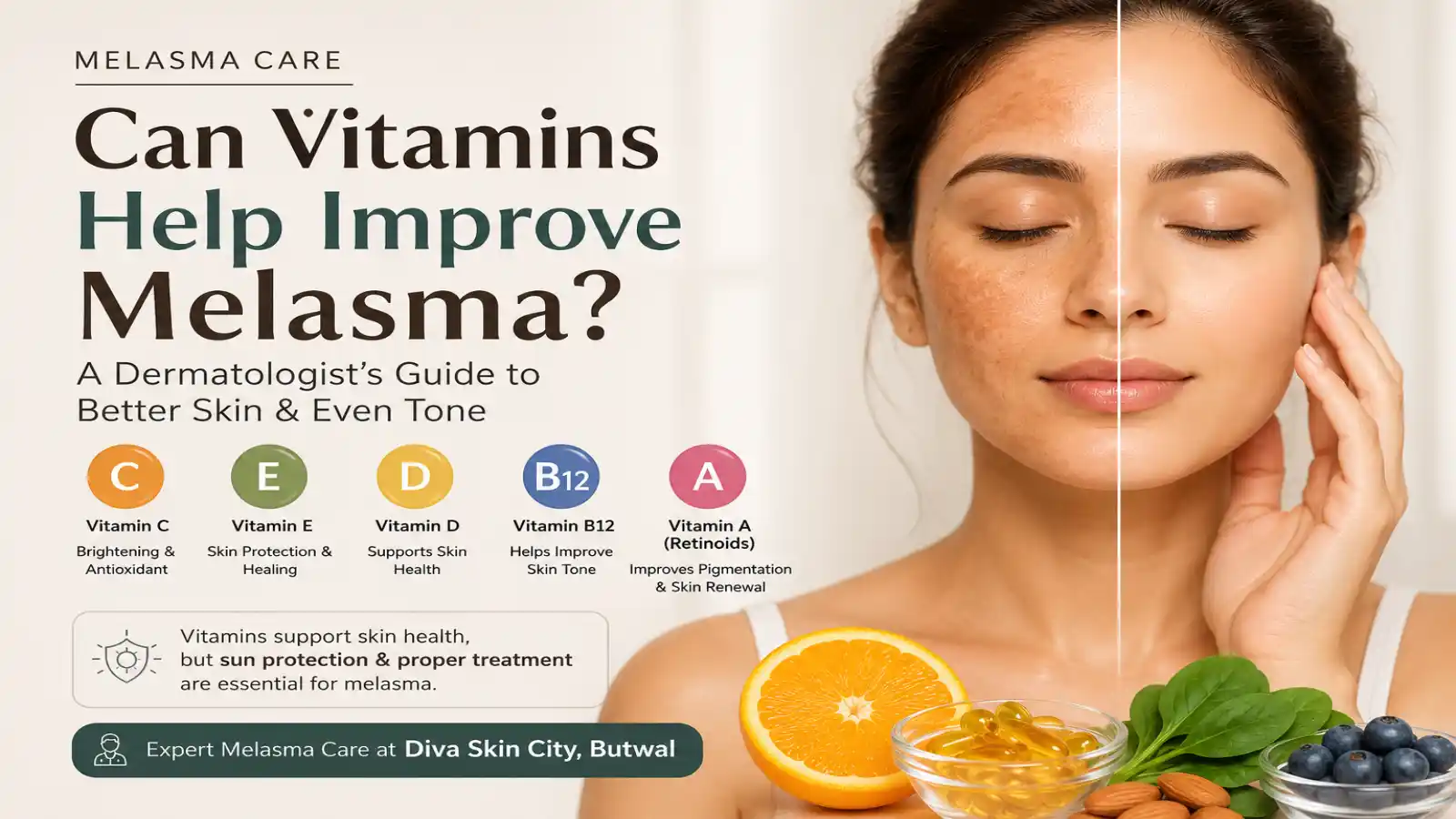
Can Vitamins Help Improve Melasma? A Dermatologist’s Guide
Melasma is a deeply stubborn, chronic pigmentation disorder that causes dark brown or grayish patches to develop on the face. It most commonly surfaces across the cheeks, forehead, bridge of the nose, and upper lip.
While it is significantly more prevalent in women—often triggered by hormonal shifts during pregnancy or oral contraceptive use—it can safely be worsened by intense UV exposure, heat, cooking radiation, and genetic factors.
During our daily consultations at Diva Skin City, Butwal, patients frequently ask us: “Can taking vitamins or applying vitamin serums cure my melasma?”
The clinical reality is straightforward: while vitamins alone cannot completely cure melasma, specific target nutrients play a massive role in supporting skin repair, shutting down excess melanin production, and lowering the oxidative stress that drives pigmentation. When combined with a dermatologist-guided treatment plan, vitamins significantly boost your recovery outcomes.
Key Vitamins That Support Melasma & Pigmentation Treatment
1. Vitamin C (The Melanin Suppressor)
Vitamin C (L-Ascorbic Acid) is celebrated as a powerhouse antioxidant in modern dermatology. It acts as a tyrosinase inhibitor, meaning it actively blocks the chemical pathway that creates excess melanin (pigment) in the skin.
Key clinical benefits include:
- Targeted Pigmentation Reduction: Fading existing dark patches without bleaching normal surrounding skin.
- Advanced Photo-Protection: Neutralizing free radicals caused by the intense Terai sun and UV radiation.
- Collagen Support: Accelerating cellular health and improving overall skin radiance.
Dermatology Note: Vitamin C is highly effective when formulated correctly into stabilized clinical serums or combined into multi-ingredient prescription creams.
2. Vitamin E (The Barrier Repair Partner)
Vitamin E (Tocopherol) is a fat-soluble antioxidant that works in perfect synergy with Vitamin C. When these two nutrients are paired together, their ability to prevent environmental sun damage doubles.
Key benefits include:
- Dropping the local oxidative stress that keeps melanocytes (pigment-producing cells) hyperactive.
- Deeply supporting skin barrier repair and cellular healing.
- Locking in essential moisture to prevent irritation from stronger medical treatments.
3. Vitamin D (The Systemic Regulator)
Deficiencies in Vitamin D are incredibly common among patients presenting with chronic skin conditions. Emerging clinical studies suggest that maintaining healthy Vitamin D levels is essential for immune regulation and overall skin cell turnover.
However, a common mistake patients make is attempting to boost their Vitamin D levels by sitting directly under the harsh sun. For individuals with melasma, unmonitored sun exposure will immediately trigger a severe pigmentation flare-up. If a laboratory blood test confirms a deficiency, controlled oral supplementation is the safest path forward.
4. Vitamin B12 and Folic Acid (Tone Correction)
Internal nutritional deficiencies—particularly a lack of Vitamin B12 or Vitamin B9 (Folic Acid)—can manifest externally as an uneven, dull skin tone or hyperpigmentation patches. Identifying and correcting these underlying internal deficits under a physician’s guidance often results in a visible improvement in baseline skin health.
5. Vitamin A / Retinoids (The Cellular Turnover Accelerators)
Vitamin A derivatives—commonly known as retinoids, retinol, or prescription tretinoin—stand as some of the most powerful toolsets we use to treat advanced melasma and deep pigmentation.
Retinoids work efficiently by:
- Speeding Up Cellular Turnover: Rapidly shedding older, pigment-laden skin cells to reveal fresh, evenly toned cells underneath.
- Enhancing Product Penetration: Allowing other localized medical treatments to reach deep epidermal layers effectively.
- Refining Texture: Smooths fine lines while actively dispersing melanin clusters.
Crucial Advice for Nepali Skin: Because high-strength Vitamin A derivatives can easily irritate sensitive or olive skin tones, they must be used strictly under a dermatologist’s supervision to prevent rebound hyperpigmentation.
⚠️ Important Rules for Managing Melasma Safely
If you are currently treating facial pigmentation, keep these medical realities in mind:
- Vitamins are Support Systems, Not Cures: While targeted nutrients optimize cellular environments, they cannot dissolve deep melasma patches on their own.
- Broad-Spectrum Sunscreen is Mandatory: Melasma management fails without strict, daily sun protection. You must apply a high-SPF, broad-spectrum sunscreen every single day—even when indoors or during cloudy days.
- Heat Protection Matters: Melanocytes are highly sensitive to thermal energy. Prolonged heat exposure from cooking stoves, saunas, or heavy styling tools can darken melasma just as quickly as sunlight.
- Avoid Unregulated Multi-Product Switching: Continuously buying viral cosmetic serums or attempting unguided skin experiments can severely damage your skin barrier, triggering an immediate and aggressive darkening of your pigmentation.
When to Stop Guessing and See a Specialist
Melasma is a deeply complex condition that often spreads through different depths of the skin (epidermal, dermal, or mixed). If your facial patches are persistent, growing wider, or failing to brighten with standard over-the-counter retail skincare, it is time for a professional, clinical assessment.
Effective, long-term melasma management typically requires a customized combination protocol. Depending on your unique skin profile, our medical team utilizes evidence-based approaches including specialized prescription creams, targeted medical chemical peels, oral pigment regulators, or advanced laser procedures.
🛑 Clear Pigmentation Safely under Expert Medical Care
Stop masking your melasma under heavy makeup or risking skin damage with viral online hacks. At Diva Skin City Butwal, we conduct deep, doctor-guided skin evaluations to outline a personalized, scientifically backed path to clear, healthy, and radiant skin.
👉 Click Here to Schedule a Customized Melasma Consultation at Diva Skin City
Frequently Asked Questions
Can taking vitamin supplements alone clear away my melasma?
No. Oral or topical vitamins serve as excellent supporting therapies to reduce oxidative stress and improve overall cell health, but they must be combined with specialized dermatologist-guided treatments to effectively dissolve established melasma patches.
Why does my melasma seem to get worse in the kitchen?
Melanocytes (your skin’s pigment-producing cells) are highly sensitive to heat. The intense thermal radiation from cooking stoves or ovens can stimulate these cells, causing your pigmentation to darken even if you stay out of direct sunlight.
Is Vitamin C safe to use on skin with active melasma?
Yes. Vitamin C is a highly trusted antioxidant that helps suppress the overproduction of melanin and brightens overall skin tone. However, it should be introduced at a stabilized, non-irritating concentration so it doesn’t cause barrier redness.
Why is retinol or prescription Vitamin A risky to use without a doctor?
While Vitamin A derivatives are incredibly powerful anti-pigmentation tools, using an incorrect strength or frequency can cause skin peeling, severe redness, and inflammation. On intermediate skin tones common in Nepal, this inflammation can quickly turn into post-inflammatory hyperpigmentation (PIH), worsening the dark spots.
About Diva Skin City Butwal
Diva Skin City is a premier, modern dermatology, venereology, and laser center located in Butwal. Co-founded and led by our expert team of Consultant Dermatologists, Dr. Deepak Ghimire and Dr. Saiyan Amatya, we bridge the gap between rigorous medical science and advanced aesthetic care.
We provide comprehensive, evidence-based treatments tailored specifically to your unique skin type, local lifestyle, and the challenging Terai climate. Our clinic prioritizes safe, completely confidential, and doctor-guided care—helping you move away from unpredictable social media trends and toward verified, scientific health.